
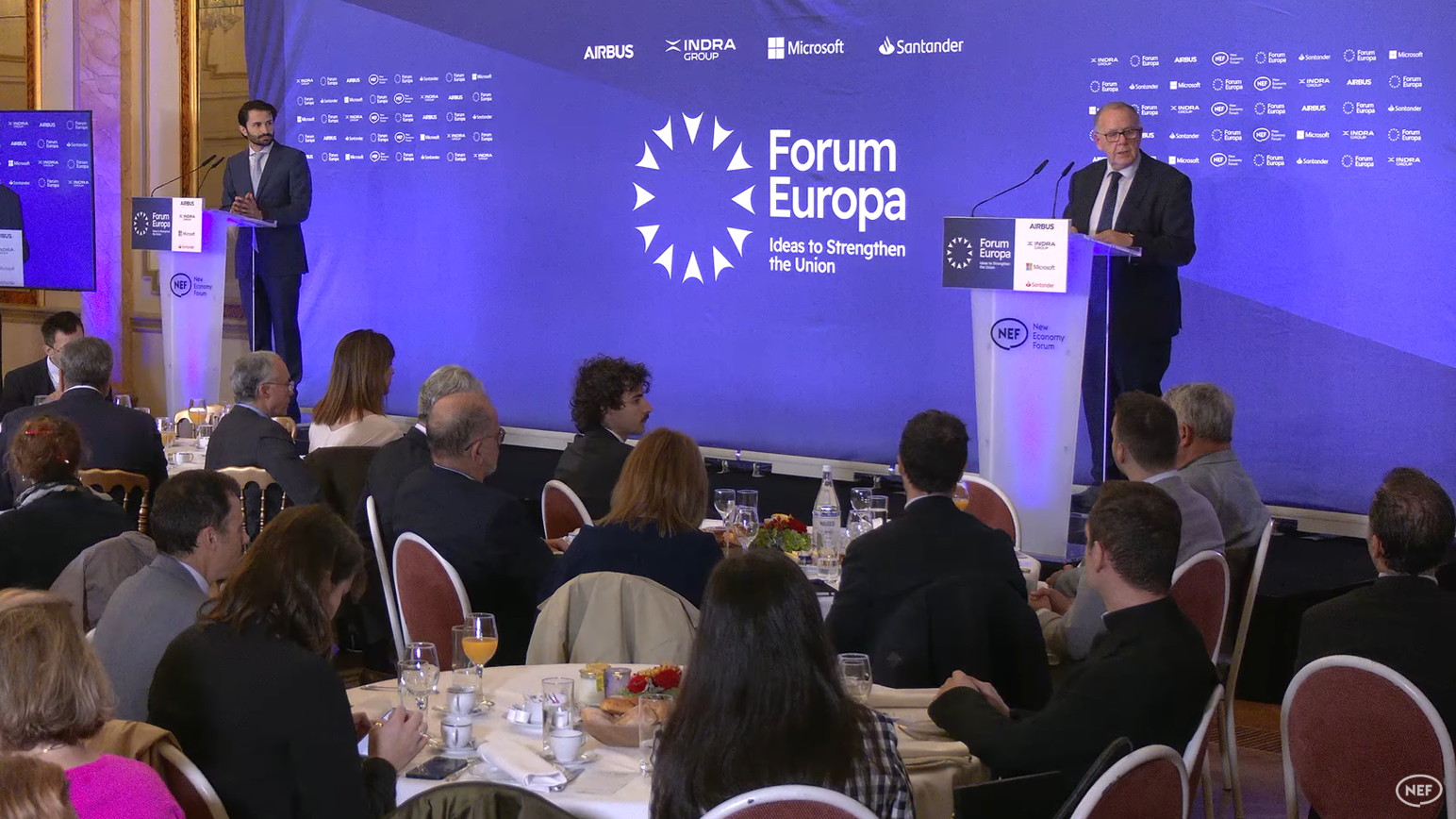
The President of the European Economic and Social Committee (EESC), Séamus Boland, stated on Tuesday at the Forum Europa in Brussels that the 2028–2034 EU budget “will not fulfil its purpose” due to the way it has been drawn up, and predicted that it will widen the gap between the EU and its citizens.
Speaking at a breakfast briefing organised by New Economy Forum in the EU capital, Boland remarked that the budget would be “a typical ‘bubble’ agreement” from Brussels, and pointed out that outside the EU “there are elections and a great deal of tension” amongst citizens in different countries.
The EESC President pointed out that budget negotiations ultimately boil down to a struggle between “the frugal states and the others”, with the former advocating budget cuts and the latter arguing for the opposite.
Aside from that debate, Boland expressed his “disappointment, to say the least”, at the allocation of funds, with agriculture remaining “practically untouched” whilst there is a cut of “27 per cent in initiatives relating to civil society participation, democracy and similar issues”.
“This is worrying, very worrying, because Europe seems to be shifting towards the far right or, I don’t know, towards extreme ideologies. So cutting the budget in that area makes no sense”, he warned.
In his view, the restraint on the budget in the social sector will only serve to alienate citizens from the European project, and he believed that, in the future, the political dynamics themselves will force the authorities to revisit these “less tangible” issues.
During his speech, Boland lamented that citizen participation in European policies is being limited to consultation. “I really hate that word. Consulting is not the same as participating”, he emphasised.
Boland acknowledged that establishing a system of dialogue with civil society can be difficult and complicated, but, in his view, it is the only way for citizens to give the system credibility and feel that it works and listens to their concerns.
The EESC President pointed out that participation is a different form of democracy, going beyond the electoral process, and stressed that this participatory democracy is “the unifying force and the necessary foundation for achieving the right approach and results”.
He also defended this participatory democracy against criticism such as that levelled by the US Vice-President, JD Vance, and pointed out that the European Union is a block of 27 states, with different cultures and languages, which must debate, engage in dialogue, reach agreement and respect each other’s points of view, because “Europe is not a dictatorship”.
Furthermore, he pointed out that the EU is a global organisation that other countries are seeking to join, referring to candidate countries such as Montenegro, Albania, Moldova and Ukraine. “We must be doing something right”, he added.
However, he lamented that the negotiations are “dragging on for too long”, when they should have been concluded at least five years ago. Despite this, he noted that the situation in Montenegro “looks promising”, as it does in Moldova and Albania, although all three “face challenging domestic issues” that they must resolve.
He also remarked that civil society organisations in these countries “maintain a strong sense of freedom” and emphasised that “freedom of expression is best exercised through civil society”.
Boland also emphasised the eradication of child poverty, not only as a way of providing opportunities for these young people, but also from an economic perspective and with a European dimension. In this regard, he explained that the key lies in tackling poverty from an early age, because afterwards “it is really too late”, and he pointed out that this should be the priority for all authorities.
One of the measures outlined was to guarantee a minimum income for their families, but this must be accompanied by action from public and private organisations and other institutions. He also highlighted the involvement of civil society as a key pillar for providing holistic support to families in need.
“There is a pattern whereby intergenerational poverty persists within these families. That is why we must break the cycle, and this cannot be achieved simply by announcing programmes for a specific group. We need to work with parents and the community,” he said.
The EESC President acknowledged that tackling poverty can be “very tough” and therefore requires far-reaching and highly specific solutions, which demand the support of civil society. Furthermore, Boland addressed the issue of children’s exposure to social media, pointing out that banning access “is a start, but not the ultimate solution”.
That definitive solution involves engaging with the major tech companies and creating a legal framework that addresses all the implications, such as the development of addictions or mental health issues in people and, above all, in young people.
“I would like the EU and the world at large to tackle this issue and start legislating properly, imposing severe sanctions on companies that fail to fulfil their responsibilities”, he urged.
Boland called on legislators to act “firmly” towards these companies and to implement restrictions and regulations that ensure young people “cannot access horrific content without this having consequences for the company”.
Finally, the EESC President considered that “it is no exaggeration to consider banning its use from the age of 13 or 14”, but encouraged going further and holding companies to account.
THANKS TO THE SPONSORSHIP OF