
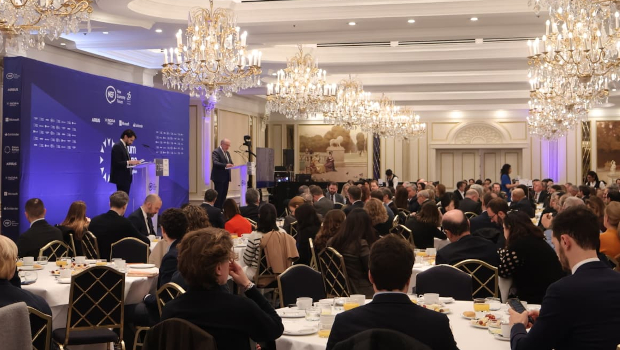
European Commissioner for Defense and Space, Andrius Kubilius, stressed this Monday at the Forum Europa in Brussels that the EU must "strengthen the resilience" of its energy systems to cope with rising prices due to unforeseen crises, such as the war in Iran.
Kubilus made this statement at a breakfast organized in the EU capital by New Economy Forum, during which he analyzed the energy consequences for the European Union of Iran's closure of the Strait of Hormuz, following the offensive launched by the US and Israel.
Kubilus was reacting to the US decision to temporarily authorize the purchase of oil from Russia, lifting sanctions imposed for the aggression against Ukraine, with the aim of combating rising prices caused by the war in Iran.
The commissioner stressed that the decision to lift sanctions against Russia “is not to our liking”, and recalled that various European Union leaders had already made this clear.
Regarding the EU's energy security and the resilience of its energy infrastructure, he considered it “undoubtedly a problem”, citing the situation in Ukraine, particularly last winter, as an example.
Kubilyus warned of the development of “new doctrines of warfare and where they are headed”, and noted that the Russians had specifically targeted Ukrainian energy infrastructure this past winter.
For this reason, he explained, some countries have promoted an initiative to develop EU instruments to “strengthen the resilience” of their energy systems. In this regard, he said that further financial investments have been proposed in the next Multiannual Financial Framework (MFF).
In his opinion, protecting the energy infrastructure of the 27 member states is “one of the crucial issues” in the area of strategic autonomy, and he stressed that the EU cannot afford to face “similar tragedies” to the one suffered by the Ukrainians.
Furthermore, he admitted that the Commission's biggest concern is oil and gas prices following the start of the war in Iran. “That was our biggest concern, and the Commission held several internal meetings on these issues, analyzing line by line what is happening and how we can predict what will come”.
On this point, he asserted that “Europe is perhaps in a more secure position than it was a few years ago”, as it is “much less” dependent on oil and gas from the Gulf countries. He also stated that “we are less dependent on Russian oil and gas, with the exception of a few countries”.
Finally, he encouraged “long-term investment to become much more independent in our energy system,” whether through renewable energies or other alternatives to fossil fuels.
THANKS TO THE SPONSORSHIP OF