
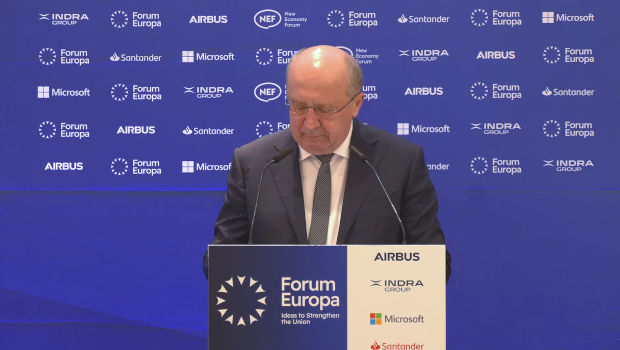
The European Commissioner for Defence and Space, Andrius Kubilius, stated this Monday at the Forum Europa in Brussels that the European Commission is “prepared to support all possible developments” in the field of Artificial Intelligence (AI), “including attracting foreign companies”.
Kubilus made this statement at a breakfast organized in the EU capital by New Economy Forum, during which he answered a question about the growing importance of Artificial Intelligence in the defense sector, and more specifically, its use in warfare.
Specifically, he was presented with the case of the US company Anthropic, one of the leading AI developers, which has been in conflict with the US Department of Defense because the firm refused to remove the ethical restrictions on its technology.
Kubilius asserted that the EU understands the importance of AI for modern defense technologies, and said that the Commission is “prepared to support all possible developments, including attracting foreign companies”.
In this regard, he noted that even if US firms “were looking to come and become a European company, we would not oppose it”. Right now, he affirmed, “we are investing considerable EU financial resources in developing our AI capabilities, and I believe we can, and should, be making progress”.
The Commissioner argued that in Europe “we tend to start slowly, but then we can demonstrate the high quality of our technological developments”, and as an example, he cited the Galileo system, which began a few years after GPS was established for navigation in the United States.
“Yes, we were late to the game, but now Galileo is three times more accurate than GPS, so technologically we are very advanced”, he emphasized. “Our problems lie in the fact that we sometimes start slowly and late”, she admitted, but she expressed confidence that in artificial intelligence “we will also be strong”.
The key, she maintained, is that “we be, so to speak, ambitious, and not allow ourselves to believe that we are so bad at technology that there is nothing to be done in Europe”.
At the end of the event, Alicia Sanchís, head of government relations for Banco Santander in Brussels, took the floor. She emphasized that the geopolitical environment “has changed radically, exposing the vulnerabilities of the European security architecture”.
Sanchís considered that, looking ahead, Europe’s security “will not depend solely on large defense companies” and championed the role “of thousands of small and medium-sized enterprises throughout the entire defense supply chain”.
Therefore, she highlighted the role of banks in enabling these companies to access capital “quickly and in the necessary amount”, since, otherwise, “European defense capabilities will not expand at the required pace”.
THANKS TO THE SPONSORSHIP OF