
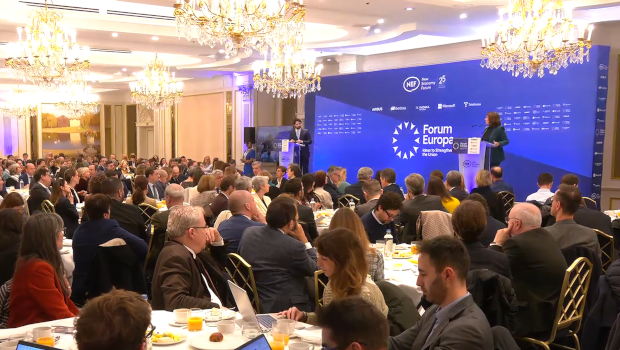
The Vicepresident of the European Commission for a Clean, Just and Competitive Transition, Teresa Ribera, argued this Tuesday at the Forum Europa in Brussels that force should be used based on pre-agreed standards and not depend on the morality of any individual, a statement she made when asked about the removal of Nicolás Maduro in Venezuela on the orders of US President Donald Trump.
Ribera made this statement at a briefing in the european capital organised by New Economy Forum, where the Spanish commissioner was introduced by Margrethe Vestager, former EU EVP and Commissioner for Competition.
Asked how the removal of Nicolás Maduro and the indirect US leadership of Venezuela will affect the world order, the Vicepresident indicated that it is necessary to consider the principles inherited "from our parents and grandparents after the Second World War". She emphasised that "the rule of law, international law", and "multilateralism" were built "to continue promoting prosperity, peace, and cooperation for humankind".
She insisted on the need to "stop depending on the morality of any individual", in a clear reference to Trump, and advocated for "rationalising the use of force according to pre-agreed standards, instead of letting it be dictated by a particular individual or anyone's preferences".
INTERNATIONAL LAW
Ribera considered that "recovering the handbook of international law could be very important" and warned that "forgetting about it will not lead us to any better future", but rather, "on the contrary, will have an enormous cost for every human being anywhere in the world".
The EU official called for "standing up to defend the rule of law" and recalled that the EU, when it began "more than 50 years ago", did not intend "to be the international political actor we now aspire to be" nor was it designed "to respond in defense of the rule of law".
However, she argued that these "are also driving forces where we can act and build" by combining "European institutions with national governments" to "unite forces and values to act and defend, not only from a European perspective, but also by building alliances with all those who still believe that the international order must be based on rules".
Ribera emphasised that this aspect "is very important for what we will have in the remaining 11 and a half months of 2026 and beyond" and underscored the importance of respecting international law in the current geopolitical context.
DEFENDING THE EUROPEAN MODEL
The European Vicepresident presented the EU model as "an open social market economy" and affirmed that it is "one of the best, if not the best, places to live" in the world, referring to the "European dream" in contrast to "some other nightmares elsewhere".
Ribera emphasised that "we never imagined that building on the foundation of respect for human rights, civil rights, and the rule of law would be threatened", and pointed out that competition is a "very particular way" of upholding legality and "predictability", while preventing "the powerful from abusing their power".
The EU official stated that in 2025, "even the most essential principles, the legacy we received from our ancestors, have been put to the test", and that "the feeling that the EU is under threat, both externally and internally, has been present".
For this reason, he called for "forgetting pessimism and fighting against pessimism, fighting for solutions" as a "common duty" for the year 2026, in a context in which he considered that "pessimism is the biggest problem for the global economy".
THANKS TO THE SPONSORSHIP OF