
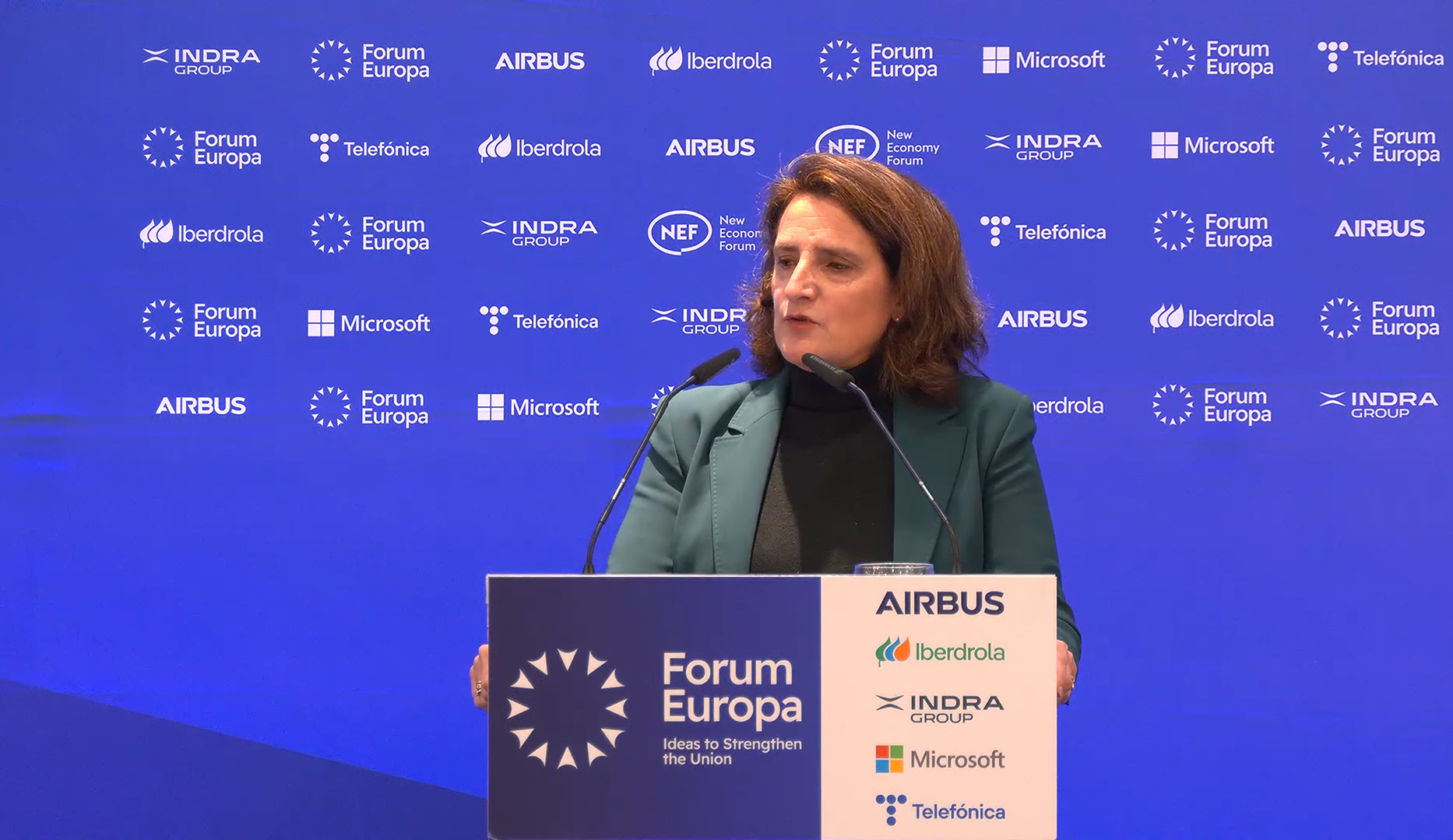
The European Commission's Vicepresident for a Clean, Just and Competitive Transition, Teresa Ribera, warned this Tuesday at the Forum Europa in Brussels that creating European champion companies should not become "a check to protect themselves from competition, which does not boost competitiveness".
Ribera made these remarks at an information session organized by New Economy Forum in the EU capital, where the Spanish commissioner was introduced by Margrethe Vestager, former EU Commissioner for Competition. The Spanish Vicepresident addressed the debate on the need to create large European companies capable of competing globally with their American or Chinese counterparts.
The commissioner argued that "creating champions, value chains, and players that can compete globally is important", and indicated that "there are very good examples of success, even in many different sectors, such as electronics", with "magnificent" companies that "compete worldwide".
However, the EU official warned that competition tools must "help support innovation and position our companies for competition" rather than provide "a check to protect themselves from competition, which does not boost competitiveness", she insisted in her address to the business forum.
CONSOLIDATION IN RELEVANT MARKETS
The European Vicepresident noted that "there has never been a problem as long as it has been framed within the relevant market to identify where consolidation needs to occur in order to compete", but warned that some want to "consolidate us in a smaller market to gain more size and profits".
Ribera criticized this strategy, stating that it "doesn't mean I'm going to compete abroad, beyond my small market", and emphasized that the "notion of champions" is sometimes used as a means to deregulate, but the problem isn't identified at the industrial base.
The Competition Commissioner added that in the "regulatory context, regarding social or environmental protection, there may be different levels of complexity that we need to simplify", and advocated for "continuing to invest in innovation and research to become much more efficient".
DEFENDING THE EUROPEAN MODEL
Ribera defended the European model as "an open social market economy" and affirmed that it is "one of the best, if not the best, places to live", referring to the "European dream" versus "some other nightmares elsewhere", in a context of increasing geopolitical pressures.
The European Vicepresident insisted that Europe must "hold fast to principles, defend values" to ensure that the message to investors and the public is that "they trust in predictability and stability" and that "the values and rules applied at the European level matter".
Ribera concluded by calling for "forgetting pessimism and fighting against it, fighting for solutions" as a "common duty" for 2026, after citing an article in The Economist that stated that "pessimism is the biggest problem for the global economy".