
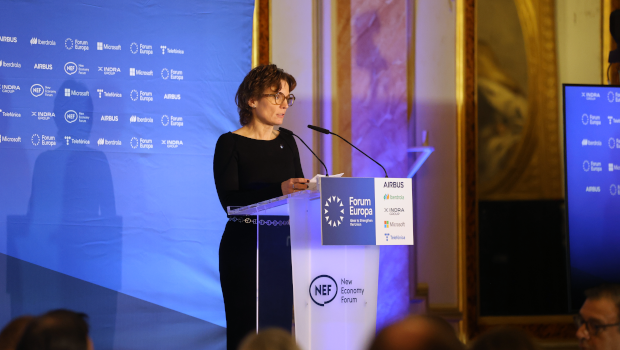
The European Commissioner for the Environment, Water Resilience and a Competitive Circular Economy, Jessika Roswall, emphasised this Friday at the Forum Europa in Brussels that the European Commission will stimulate demand for biological products to help the EU meet its climate goals and gain competitiveness globally.
Roswall indicated at this briefing organised by New Economy Forum in the EU capital that the European Commission adopted a new bioeconomy strategy this Thursday that contributes “significantly” to job creation and economic growth in the EU, as it generated €2.7 trillion in 2023 and employs 17.1 million people (8% of total jobs in the EU).
“The European bioeconomy strategy will help us build a more resilient and competitive Europe. It will also reduce our dependence on fossil fuels and mitigate the impact of climate change. We want to lead the biotechnology revolution, and Europe is full of innovative ideas and solutions”, she stated.
In this regard, Commissoiner Roswall emphasised that “the Commission will boost demand for products with bio-based content”. “We want to make the most of every ton of bio-based material. We need to promote sustainable and locally manufactured materials and chemicals. And we need to overcome our dependence on fossil fuel reserves”, she reiterated.
“POTENTIAL”
Roswall mentioned the “potential” of bio-based building materials and chemicals, textiles, plastics, and fertilszers, as well as technologies such as biorefineries and advanced fermentation.
“We must manage Europe’s forests, our soils, our seas, and other ecosystems responsibly and strategically within ecological limits. Because without healthy ecosystems, there is no bioeconomy. And without the bioeconomy, Europe cannot meet our climate goals or become competitive”, she added.
Therefore, she commented that the EU wants to “reward” farmers so that they “protect carbon sinks while providing food, materials, and energy to the European market”.
On another note, Roswall highlighted that the European Commission will present a Circular Economy Act next year with additional measures on plastics. “For example, we need to ensure that extended producer responsibility rates are modeled effectively. That means they reflect the relative cost of managing them as waste”, she added.
For the Commissioner, both the bioeconomy strategy and the Circular Economy Act are part of “a systematic effort to build a more competitive economy and a more prosperous society”.
THANKS TO THE SPONSORSHIP OF