
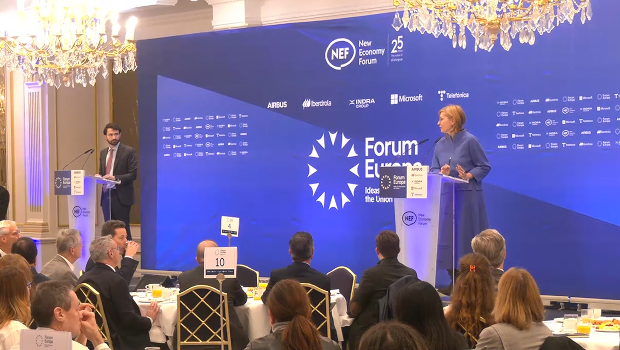
The European Commissioner for Startups, Research and Innovation, Ekaterina Zaharieva, highlighted on Friday at the Forum Europa in Brussels that the EU will launch the “Scale Up Europe Fund”, a multi-million euro initiative aimed at investing in the most promising European companies in strategic sectors of “deep tech” or disruptive technologies. The aim is to create "world champions" in advanced technologies.
Zaharieva made this announcement at an informative meeting organised by New Economy Forum in the EU capital, where she explained that the new public-private fund will have €1 billion from the 'Horizon Europe' programme, while another €5 billion is expected to be raised from private investors.
She explained that Europe creates more start-ups than the US and has good instruments to support initial capital, but "when it comes to scaling up, to becoming first European and then global leaders, we really fail to scale up those companies".
She specified that the fund will be "the largest technology venture capital fund in Europe" and they expect to receive €5 billion in contributions from the private sector, being "absolutely market-driven" and managed by private fund managers.
AVOIDING THE EXIT OF COMPANIES
She stated that she knows of "countless truly promising start-ups with truly unique technologies" created in Europe and initially financed with taxpayers' money, but "when they have to scale up, most of the time they have no choice but to leave Europe".
She argued that, although the ideal solution would be to complete the single market, including the capital markets union, "we cannot waste time" or "wait for this to happen" for these structural reforms.
The Commissioner indicated that the fund's objective is to invest in the growth of companies, which explains why this new instrument will be called a "scale-up fund" to differentiate it from other existing financing instruments in the EU.
She assured that the resources will come from the Horizon Europe programme without asking "more money from Member States" and without changing current priorities or "reducing the funds in the instruments we have".
SINGLE TECHNOLOGY MARKET
She advocated the need to create a "single technology market" through the new 'Horizon Europe' programme, which proposes doubling the budget to €175 billion for the next programming period.
She argued that the programme should facilitate "the free movement of knowledge technologies and scientists across the continent" and provide "cutting-edge technological and research infrastructures" to scientists, researchers and innovators.
Zaharieva considered it essential to establish "a really strong connection" between the second pillar of 'Horizon Europe' and the European Competitiveness Fund in order to "translate these results and bring them to the research market".
She believed that this connection would help to "deploy these innovation and research results in the market, turn them into products and bring them to market" in order to create companies on a European scale.
SCIENTIFIC FREEDOM UNDER THREAT
She warned that "the freedom of expression and scientific freedom that we cherish are under threat" and that "bad actors are promoting instability and undermining our democracy".
She also stated that Europe must "be the home of scientific freedom" and "a beacon for the world and a place where innovation is not only valued but supported with adequate resources".
She declared that "scientists must be free to ask the big questions, without being constrained by anyone's agenda, and innovators must have the means to create new businesses".
Finally, Zaharieva announced that scientific freedom will be incorporated into the future European Research Area Act, following the recommendations of the European Parliament, which requested that this principle be included in EU legislation.
THANKS TO THE SPONSORSHIP OF