
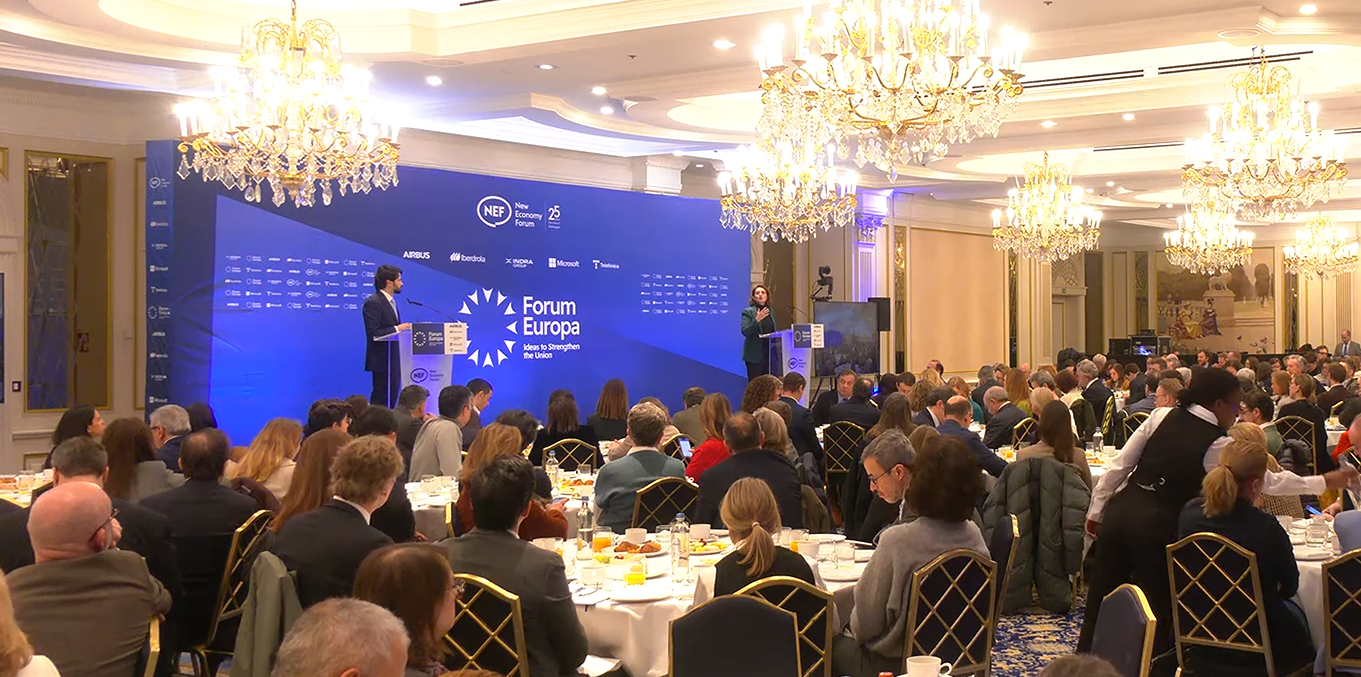
The European Commission's Vicepresident for a Clean, Just and Competitive Transition, Teresa Ribera, argued this Tuesday at the Forum Europa in Brussels that EU energy security is "much more anchored in initiatives that return to clean, domestically produced energy" compared to dependence on imported fossil fuels.
At a briefing organized by New Economy Forum in the EU capital, Ribera was introduced by former EU Competition Commissioner Margrethe Vestager. The Spanish Vicepresident was responding to a question about how Europe is guaranteeing energy security as a foundation for long-term competitiveness from a sustainability perspective.
Ribera emphasized that "it is very difficult to be competitive, reliable, and secure if we depend on something we don't produce" and advocated for a complete overhaul of the energy model through initiatives that prioritize locally produced clean energy to reduce vulnerabilities and external dependencies.
The EU official insisted that European energy security depends on "locally produced clean energy" and indicated that this "means rethinking" both the system and "the capacity to produce energy" and "eventually, the electricity that could be demanded" on the European continent.
"CONNECTING EUROPE"
Ribera highlighted that "there are great opportunities surrounding this clean electricity production and its integration into the system" and added that Europe has "a great opportunity to build a stronger Europe through a European energy policy and through the network package" that will connect the continent.
The European Vicepresident emphasized the importance of "connecting Europe" to ensure "that digitalization, cybersecurity, and the ability to fully leverage the various complementarities of our continent are successful" and generate industrial opportunities around the production of clean goods and equipment.
Ribera argued that "the faster, more securely, and more opportunities we identify in the industrial hub around the production of these goods, equipment, and related services, the more opportunities we will be building for Europeans" and for digital players who can bring efficiency to the system.
The Competition Commissioner also raised the need to assess how "this growing demand from a new player could challenge the way we have managed it so far from a competition and energy regulator perspective" in light of the increasing electricity consumption of digital services.
AID FRAMEWORK
Regarding the Clean Industrial Pact, Ribera explained that the state aid framework adopted in 2025 aims to "ensure everyone understands what we're talking about" and to enable Member States to support industrial transformation "while minimizing the risk of distortion" in the European single market.
The European Vicepresident specified that "more than €18 billion has been allocated to projects and initiatives under clean industrialization" since the summer and emphasized that the framework has been "quite well received" by Member States willing to participate in this transformation.
At the end of the meeting, Eva Chamizo, Director of European Affairs and head of Iberdrola's Brussels office, took the floor and called for "eliminating the barriers we ourselves are imposing on our future competitiveness" in the energy sector on the continent.
Chamizo called for "freeing electricity from the taxes it has compared to gas" and criticized Europe for "taxing the local, indigenous and clean source of electricity so much compared to the fossil fuel that we have to import and that, in the end, we are subsidizing" with contradictory tax policies.
THANKS TO THE SPONSORSHIP OF