
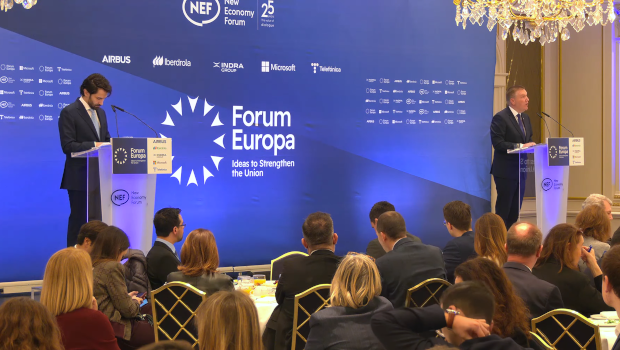
The European Commissioner for Democracy, Justice, the Rule of Law and Consumer Protection, Michael McGrath, announced this Thursday at the Forum Europa in Brussels that next month he will present the proposal for the 28th Regime to the College of Commissioners. This optional, digital European corporate framework is designed to facilitate the creation, expansion, and investment of companies throughout the Single Market.
McGrath made these remarks while participating in an information session organised by New Economy Forum in the EU capital.
Regarding the legal basis of the 28th Regime, McGrath indicated that his "preference is for it to be a regulation", although he acknowledged that "we must ensure that the legal basis is appropriate". The Commissioner explained that the Commission's published work program established "two possible legal bases: one would be a directive, the other would be a regulation".
McGrath argued that "the goal of harmonisation would be best achieved through a regulation, where feasible," because "one of the things we are trying to move away from is fragmentation". The EU official warned that "if we end up with different ways of implementing a 28th regime in the 27 Member States, then the whole purpose of it begins to unravel".
The Commissioner guaranteed that the 28th regime "will not undermine, either directly or indirectly, the very high level of labour rights we have for workers across the EU". He emphasised that "there will be no circumvention of EU labour law" and maintained that labour rights in Europe are "a unique competitive advantage" that "we must defend and protect”.
Regarding the scope of the initiative, McGrath indicated that "the focus is on ensuring an enabling environment for innovative companies, for startups, companies that are scaling up within the European Union". By its very nature, he believes the concept of the 28th regime "will be more attractive and more useful for companies operating in that area".
"A COHERENT SET OF RULES"
McGrath described this EU Inc. initiative as a European Commission proposal to create a single corporate legal status that would allow companies, especially startups and SMEs, to operate throughout the EU under a single regulatory framework.
This plan aims to "reduce fragmentation and allow companies to operate across the single market under a coherent set of rules". He stressed that "it sounds simple" but acknowledged that "there's a reason it hasn't happened so far: it's difficult, it's complex, and it requires broad political support".
According to the Commissioner, EU-INC "is at the heart of our ambition to address the challenge of European competitiveness" and will allow companies to establish themselves and grow across borders "more quickly and seamlessly using digital tools such as the EU Enterprise Certificate".
FOUR KEY PILLARS
McGrath explained that EU Inc. will be built on four key pillars.
First, it will be "a digital-by-default framework" that will allow companies to establish themselves and grow across borders more quickly.
Second, it will be based on "flexible and modern governance" that will offer "adaptable governance tools that reflect the realities of how modern companies are created and grow".
The third pillar will provide "better tools to attract and retain talent", making it easier for companies to offer "competitive forms of remuneration, including employee share options with harmonized features that work across the EU".
Finally, the fourth pillar will guarantee "better access to investment" by streamlining "how companies raise capital across borders".
The Commissioner argued that this initiative responds to the fact that "for too many entrepreneurs and innovative companies, expanding across borders still means navigating a fragmented landscape, often bewilderingly complex and fraught with legal uncertainty". McGrath added that "this complexity hinders growth, we know it increases costs, and it discourages expansion".
RULE OF LAW AS A "STRATEGIC ASSET"
At the same time, McGrath argued that "competitiveness is not just a matter of speed or scale; it is also a matter of trust: the trust to invest, innovate, and grow". The Commissioner emphasised that the rule of law "is also something more: a strategic asset and perhaps the most undervalued source of European competitiveness".
The EU official explained that "for businesses, the rule of law means something very concrete: stable market conditions, clear rules, and predictable enforcement". He added that "when businesses can count on stable rules and independent institutions, they can trust the market and invest, innovate, and grow".
The Commissioner warned that "when the rule of law weakens, when rules become arbitrary, enforcement becomes unpredictable, courts become less than fully independent, and our legal certainty gives way to political interference, we know there is an economic cost, and we know it is immediate".
Finally, McGrath emphasised that the Commission reinforced "the Single Market dimension in its annual Rule of Law Report last year, demonstrating its added economic value", and argued that "in a world marked by volatility and uncertainty, Europe will continue to stand out as the place that guarantees market confidence by ensuring stability".
THANKS TO THE SPONSORSHIP OF