
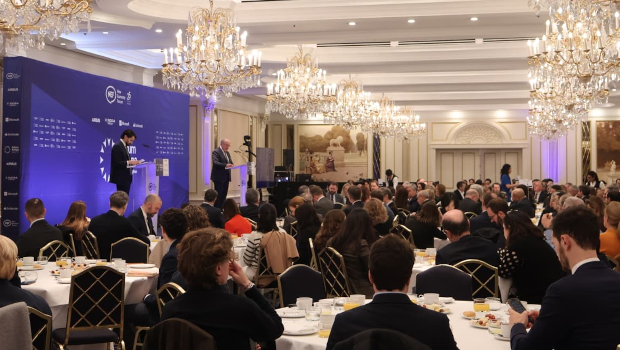
European Commissioner for Defence and Space, Andrius Kubilius, called on Monday at the Forum Europa in Brussels for a “common vision” in the space sector for both Member States and the European Commission and the ESA, so that “if the 27 invest in developing capabilities, these capabilities must be interoperable”.
This was the proposal championed by Andrius Kubilius at a breakfast organized in the EU capital by New Economy Forum, during which he offered some details of the plan for developing the European Space Shield, which the Commission is expected to publish in the second half of this year.
Kubilus advocated for a “holistic approach” in the space sector, since, he said, the Commission is working on different initiatives, such as the one aimed at secure satellite communications.
Specifically, he assured that there is progress in the plans. Community members will have a service to obtain “highly accurate intelligence data, almost in real time, from space”. He also commented that another key element will be strengthening the Galileo system, and claimed he could point to several examples, stating that “it would be very important for us to have a global vision”.
The commissioner noted that member states, which are now “quite radically” increasing defense spending, are also allocating funds for the necessary space capabilities in the defense sector.
From this perspective, he considered this policy positive, as he believes the EU will need “mass in space”, with a significant number of satellites, prepared and focused on different space projects.
But he stressed that this diversity of projects across the 27 member states requires, from the outset, that all actors in the European space sector—member states, the European Commission, and the ESA—“have a common vision,” as he described it as fundamental that “if member states invest in developing capabilities, these capabilities must be interoperable”.
With this integration, “In the end, we would have several hundred satellites in space”, for example, for the future Earth Observation Governmental Service (EOGS). Some of these satellites would be national and others European, “but they could communicate with each other”.
In that case, he emphasized, “we would have the real possibility of obtaining intelligence from real-time space data,” something that depends on the number of satellites.
To explain this, he referred to the frequency with which a precise satellite image of the same location is obtained, and argued that currently in Europe, with Copernicus, it is possible to view the same location once a day. “The Chinese are developing systems that, according to experts, will allow us to view the same location every six minutes”, although he indicated that for the EU, “30 minutes will be sufficient”.
THANKS TO THE SPONSORSHIP OF