
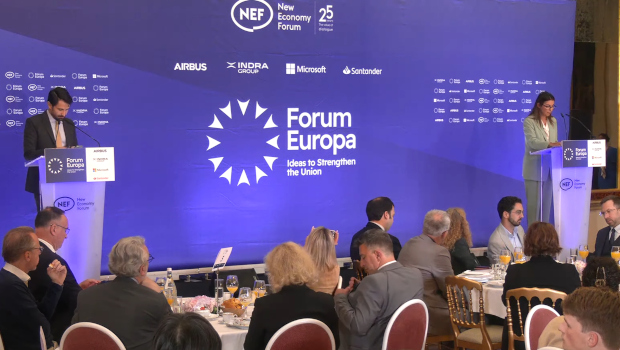
The European Ombudsman, Teresa Anjinho, stated on Wednesday at the Forum Europa in Brussels that text messages sent by public officials and civil servants via instant messaging apps, such as WhatsApp, should be retained in case they need to be consulted in the future to verify the content of their decisions.
Anjinho made this point at an information session organised in the EU capital by NEconomy Forum, where she warned that digital communication channels have become routine in political activity and create “a growing grey area” in which far-reaching decisions are taken that may leave no trace and escape public scrutiny.
She noted that public officials and civil servants now communicate in a very different way to how they did a decade or two ago, when the current EU regulations were adopted. She warned that important information shared via these channels “may be accidentally deleted, never recorded, or simply forgotten”, posing risks to accountability despite the efficiency gains they bring.
In this regard, the Ombudsman explained that she is conducting an ongoing investigation aimed at establishing clearer principles in this area concerning the communications of civil servants and public officials. She noted that the focus of this investigation is that any document subject to a request for access, including an instant message, should be stored immediately, regardless of whether the institution believes that access will ultimately be granted.
She argued that retaining digital communications would allow an independent body such as the European Ombudsman to assess whether the decision taken was correct and to assure the public that nothing had been deliberately concealed. Transparency, she emphasised, “is not just about what is disclosed, but also about what is retained”.
Asked whether an official WhatsApp message should be treated as just another document, she revealed that she is finalising an investigation into the agreement with Mercosur, specifically linked to text messages, on which she expects to issue a decision shortly. She recalled that the previous case involving the pharmaceutical company Pfizer had already demonstrated, following the court ruling, the need for a better system for managing and recording such communications.
She acknowledged that many policymakers use instant messaging to exchange information or create groups as part of "this new world", but stressed that these informal spaces "are not exempt from accountability". The essential thing, she said, is to ensure record-keeping, traceability and oversight.
He concluded that confidentiality "is not, and cannot be regarded as, the opposite of transparency", and that many of these messages are unlikely to be disclosed because they are repetitive, internal in nature, or subject to an exception, such as international relations or public security.
THANKS TO THE SPONSORSHIP OF