
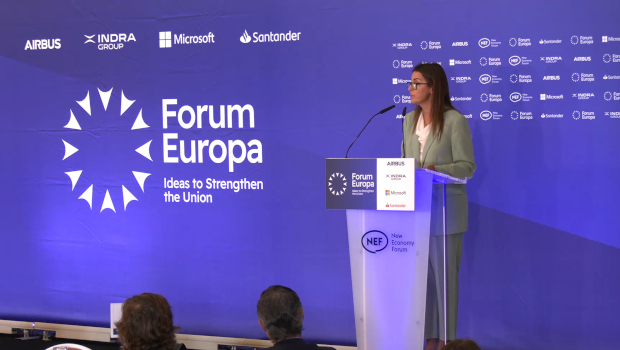
The European Ombudsman, Teresa Anjinho, stated on Wednesday at the Forum Europa in Brussels that public transparency should never be regarded as “a courtesy”, but rather as “the reward owed” to citizens for their trust in the government and public institutions, and she therefore argued that it is a “fundamental right” that is increasingly being ignored.
Anjinho made this point at an information session organised in the UE capital by New Economy Forum, where she argued that the consent of the governed, the basis of democracy, “cannot be given in the dark” and that citizens have “the right to know, the right to see, understand and evaluate” what institutions are doing.
The Ombudsman warned that the pressure of successive crises is pushing governments to speed up decision-making and centralise power, whilst citizens are demanding greater visibility over how decisions are made. This disconnect creates what she termed “a legitimacy gap” which, if left unaddressed, erodes the trust that underpins democratic institutions.
She revealed that almost 40% of her office’s investigations in 2025 concerned transparency issues, a figure similar to that of 2024. She warned that part of the EU administration has turned access to documents into a “bureaucratic process” rather than the guarantee of a fundamental right.
Anjinho identified three trends that threaten openness. The first is delays: he lamented that institutions treat each request “as a potential legal liability” and push deadlines to the limit, to the extent that the European Commission frequently exceeds the legal time limits for processing requests for access to documents.
The second is the misuse of exceptions. He noted that the regulations provide for legitimate exceptions to protect privacy, commercial interests or public security, but stressed that these must be applied “strictly” and on the basis of demonstrable harm, not invoked in a generic manner.
As an example, she cited a recent case of maladministration in the Commission’s handling of a request concerning social media platform ‘X’ and its compliance with the Digital Services Act. Instead of examining what could be disclosed, the European Commission ruled that exceptions applied, “without carrying out any real analysis”, something the Ombudsman deemed “unreasonable”.
Anjinho also addressed the issue of text messages and instant messaging apps. She noted that these have become routine in political activity and create “a growing grey area” where decisions can disappear without a trace, beyond public scrutiny.
The Ombudsman argued that institutions should invest in “a culture of proactive transparency”, with adequate resources and governance models that facilitate openness from the outset, as well as ensuring that the information published is “easy to find, easy to access and easy to understand”.
She emphasised that good governance “is democracy in action” and that this “does not stop at the doors of institutions”, but is practised every day when public officials respond to citizens and citizens engage constructively with institutions.
THANKS TO THE SPONSORSHIP OF