
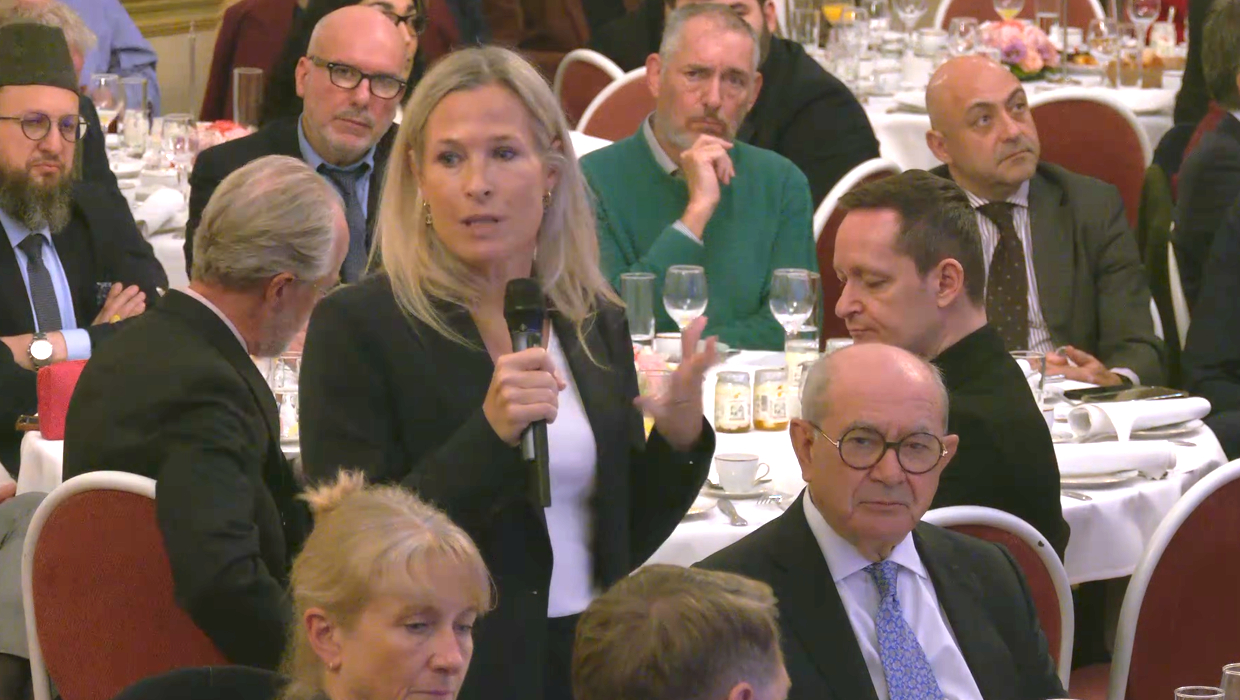
Katarina Wallin Bureau, Microsoft’s Vice-President and Head of Strategic Relations with the EU, defended the ties between the European Union and the United States at the Forum Europa in Brussels, and called for the transatlantic relationship to be sustained because together we are stronger.
Katarina Wallin Bureau made these remarks during a breakfast briefing organised by New Economy Forum in the EU capital, where she spoke at the end to round off a conference by the US Ambassador to the EU, Andrew Puzder.
As a representative of one of the event’s sponsors – alongside Airbus, Indra Group and Santander – the Microsoft executive noted that her company has “deep roots” on both sides of the Atlantic. She therefore emphasised that, to ensure the transatlantic relationship endures, trust, technology and security are essential.
On the subject of trust, she argued that the transatlantic relationship has never been based on agreeing on everything, but rather on knowing that, even when there are differences, “together we are stronger”. “The solution to differences between allies is more dialogue, not distance”, she emphasised.
On the subject of technology and competitiveness, she stated that Europe is entering a decisive phase in Artificial Intelligence (AI), moving away from “merely drafting regulations” to focus more on “the practical application of the technology”.
Wallin Bureau stated that Europe’s competitiveness will depend not only on the development of AI and collaboration with partners in its development, but also on how it implements this technology across various sectors, businesses and public services.
In this regard, she said that “neither side of the Atlantic has everything it needs on its own”, and therefore called for collaboration between the United States and Europe.
Finally, with regard to security, she argued that threats today “do not stop at national borders”, and that cyber-attacks, hybrid warfare and attacks on critical infrastructure affect everyone equally.
Security, therefore, also depends today on interoperability, on alliances based on trust and on shared responsibility.
THANKS TO THE SPONSORSHIP OF